

Sellers · 9 min read
Calculating Your 2026 Orange County Seller Net Sheet
| Paul Phan, Realtor®
Selling an Orange County home involves more than just a top-line sales price. Understanding your seller net sheet ensures you know exactly what you will walk away with after closing costs, taxes, and fees.
Key Takeaways
- A Seller Net Sheet details the exact financial proceeds you will receive after all closing costs, loans, and fees are paid.
- In Orange County, sellers customarily pay for the Owner's Title Insurance policy, while escrow fees are typically split 50/50.
- Orange County levies a Documentary Transfer Tax of $1.10 per $1,000 of the final sales price.
- Real estate commissions in 2026 are structured as a negotiated listing fee and an optional, negotiated buyer broker concession.
- Property tax prorations, HOA transfer fees, and termite clearances can add thousands to your closing costs.
- Consult a CPA to understand your capital gains tax exposure and potential Proposition 19 benefits before selling.
The Reality of Selling Real Estate in Orange County
When a homeowner in Orange County decides to sell, the focus naturally gravitates toward the gross sales price. Whether you are listing a mid-century tract home in Westminster, a sprawling estate in Irvine, or a coastal property in Huntington Beach, seeing a multi-million-dollar valuation is exciting. However, the gross sales price is not the amount that will ultimately be wired into your bank account at the close of escrow.
To understand your actual financial takeaway, you need a Seller Net Sheet. This financial document provides a line-by-line breakdown of the costs associated with transferring property ownership in California. From title insurance and escrow fees to county transfer taxes and negotiated buyer concessions, the costs of selling a home are substantial and highly specific to local customs.
In 2026, understanding your net sheet is more critical than ever. With recent structural changes to how real estate commissions are negotiated and paid, alongside shifting buyer expectations regarding repair credits and interest rate buydowns, sellers must have a granular understanding of their closing costs.
The Anatomy of an Orange County Seller Net Sheet
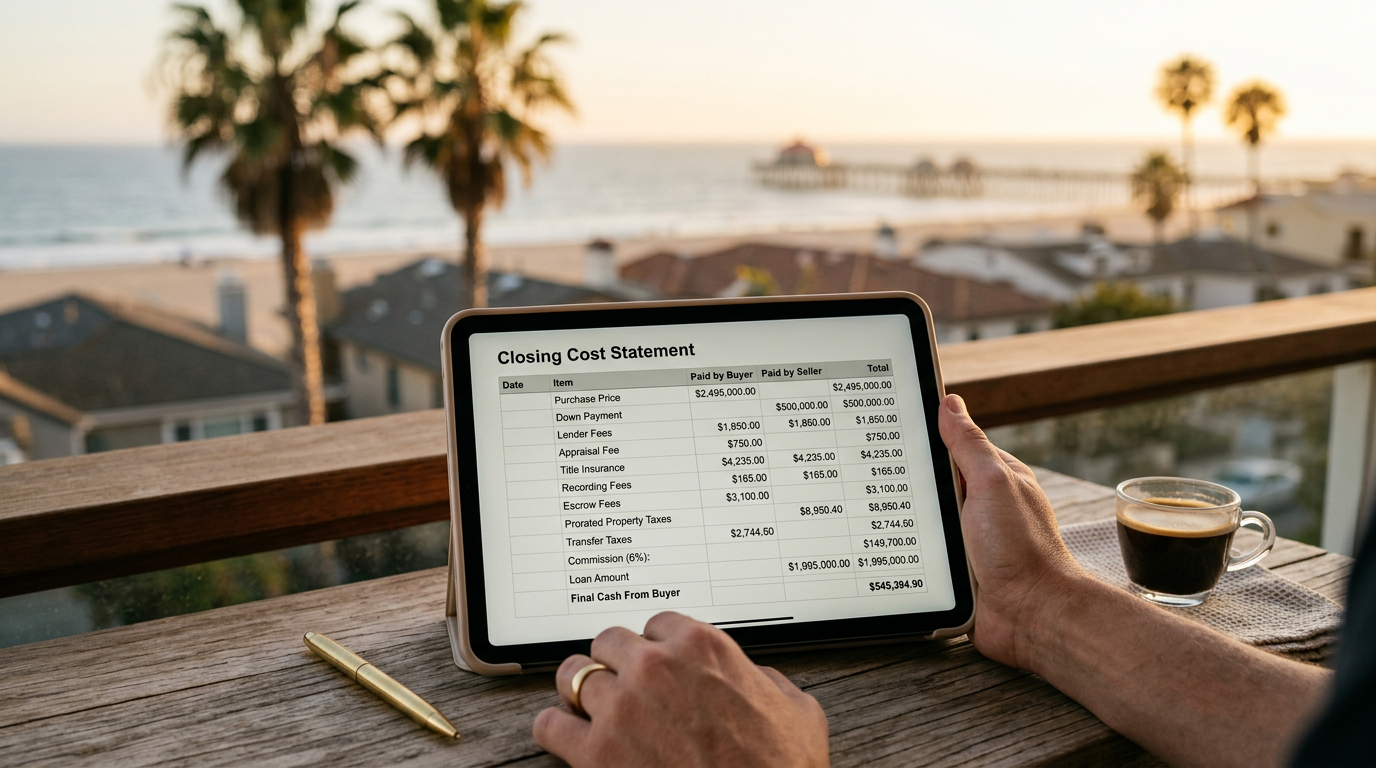
A Seller Net Sheet is essentially a ledger of estimated credits and debits. It starts with the accepted purchase price of your home and subtracts every fee, payoff, and tax required to close the transaction.
Because real estate customs vary drastically by state—and even by county within California—it is vital to use a net sheet tailored specifically to Orange County. For example, in some Northern California counties, buyers customarily pay for the owner's title insurance policy. In Orange County, that cost is traditionally borne by the seller. Relying on a generic online calculator will almost certainly yield inaccurate results, potentially leaving you tens of thousands of dollars off in your financial planning.
County and City Documentary Transfer Taxes
When real property changes hands in California, the government levies a Documentary Transfer Tax.
The base rate for Orange County is $1.10 per $1,000 of the home's final sales price. If you sell a property in Santa Ana for $900,000, your county transfer tax will be exactly $990. This is a straightforward, non-negotiable fee paid by the seller at closing.
Unlike Los Angeles County, where many municipalities (and the city of LA itself) levy massive additional city-level transfer taxes (often referred to as "mansion taxes"), most cities in Orange County do not have an additional city transfer tax. However, it is always prudent to verify, as local ordinances can change. Your escrow officer will calculate this exact amount prior to closing.
Mortgage Payoff, Prepayment Penalties, and HELOCs
Naturally, any existing liens on the property must be satisfied before the title can transfer to the buyer. This includes your primary mortgage, any secondary mortgages, and Home Equity Lines of Credit (HELOCs).
When estimating your net proceeds, do not simply look at your last mortgage statement balance. Mortgage interest is paid in arrears. If you close escrow on the 15th of the month, you will owe 15 days of prorated interest to your lender. Additionally, lenders typically charge a minor "reconveyance fee" (usually around $65 to $150) to formally remove their lien from the public record, along with wire fees for the payoff.
While rare on modern conventional loans, some older loans or specific private financing terms may include prepayment penalties. If you are unsure, you must request a formal payoff demand from your lender during the escrow period.
Property Tax Prorations and Supplemental Taxes
California property taxes are billed in two installments: the first is due November 1 (delinquent December 10), and the second is due February 1 (delinquent April 10).
Depending on when your home closes escrow, you will either owe prorated property taxes to the buyer, or the buyer will owe prorated taxes to you. For example, if you paid your full annual tax bill in December, but you sell your home in March, the buyer will credit you back for the months of April through June that you already paid for.
Sellers in newer developments in Irvine, Tustin, or South County must also account for Mello-Roos or special assessment prorations. These are billed alongside your standard property taxes and are prorated in the exact same manner.
HOA Fees, Document Preparation, and Transfer Fees
If your home is located within a Homeowners Association—a common reality in cities like Irvine, Newport Beach, and parts of Costa Mesa—you will encounter HOA-specific closing costs.
By California law, sellers must provide buyers with a comprehensive package of HOA documents, including CC&Rs, bylaws, recent meeting minutes, and financial statements. HOA management companies charge a document preparation fee for this package, which can range from $300 to $600.
Additionally, most HOAs charge a "transfer fee" to update their records with the new owner's information. Customarily, the seller pays this fee in Orange County, though it can be negotiated.

Mandatory Repairs, Termite Clearances, and Concessions
While not fixed "fees," repair costs and buyer concessions heavily impact your final net sheet.
Termite (Wood Destroying Pest) Clearance: It is highly customary in Orange County for buyers to request a termite inspection. If the buyer is using a VA loan to purchase your home in Garden Grove or Anaheim, a clear Section 1 Termite Report is often a lender requirement. Sellers frequently pay for the inspection (around $100) and are often negotiated into paying for Section 1 repairs (active infestations or dry rot), which can range from a few hundred dollars for localized treatment to several thousand for full tenting.
Buyer Concessions: In the 2026 market, buyers facing higher borrowing costs may request seller concessions instead of a price reduction. A buyer might ask for a $10,000 credit toward their closing costs to buy down their interest rate. If you agree to this during the Request for Repair negotiation phase, this $10,000 will be debited directly from your proceeds on the net sheet.
Capital Gains Taxes and Proposition 19 Considerations
While capital gains taxes do not appear on your escrow net sheet (they are paid later when you file your income taxes), they are the most critical factor in your true "net" profit.
Under Section 121 of the IRS tax code, if you have lived in the home as your primary residence for two of the last five years, you can typically exclude up to $250,000 of capital gains if you are single, or up to $500,000 if you are married filing jointly. Given the rapid appreciation of Orange County real estate over the last decade, many long-term homeowners exceed these exemption limits.
For homeowners aged 55 and older, Proposition 19 offers a powerful tax benefit. It allows eligible sellers to transfer their current, often very low, Prop 13 property tax base to a replacement home anywhere in California up to three times. This can drastically change the financial math of downsizing or relocating.
*Disclaimer: Real estate agents are not tax professionals. You must consult a qualified CPA or real estate attorney to determine your specific capital gains exposure and Prop 19 eligibility before listing your home.*
Example Net Sheet Breakdown: A $1,200,000 Orange County Home
To illustrate how these fees compound, here is a hypothetical breakdown for a $1,200,000 sale in Orange County. (Note: These are estimates for educational purposes; actual negotiated rates and escrow fees will vary).
Maximizing Your Net Proceeds with Expert Guidance
Understanding your net sheet is the foundation of a successful sale, but optimizing that bottom line requires strategic execution. The goal is not merely to minimize fees, but to maximize the gross sales price through meticulous preparation, aggressive marketing, and skilled negotiation, ensuring your final net figure is as high as possible.
At The Maison by Phan Group, we provide our clients with highly detailed, conservative net sheets before a property ever hits the market, and we update them every time an offer is received. This ensures you make decisions based on real math, not guesswork.
If you are considering selling your Orange County property and want a precise calculation of what your home will yield in the current market, contact Paul Phan, Realtor® at (714) 717-8088 or paul@maisonbyphan.com to schedule a private consultation and request a custom Seller Net Sheet.
Disclosure
Market information is provided for general education and reflects conditions at the time of writing. It is not legal, tax, or investment advice.
Frequently Asked
Who pays for escrow fees in Orange County?
By local custom in Orange County, the base escrow fees are split evenly (50/50) between the buyer and the seller. However, specific loan tie-in fees or document preparation fees may be assigned to one party based on the purchase agreement.
How much is the transfer tax in Orange County?
The Documentary Transfer Tax in Orange County is $1.10 per $1,000 of the property's final sales price. Most cities in Orange County do not charge an additional municipal transfer tax, keeping this cost predictable.
Do I have to pay the buyer's real estate agent?
No, you are not legally required to pay the buyer's agent. However, offering a buyer broker concession is a common and highly effective negotiation tool to attract more buyers, especially those using VA or FHA loans who cannot finance their agent's fees.
Are capital gains taxes deducted at the close of escrow?
No, capital gains taxes are not deducted by escrow and will not appear as a debit on your final closing statement. You are responsible for reporting the sale and paying any applicable capital gains taxes when you file your annual income tax return.
Talk it through
Have a question about your own situation?
Paul Phan represents buyers and sellers across Orange County — in English and Vietnamese.
(714) 717-8088Continue reading
Investors
The Orange County Rental Market: Should You Sell or Keep and Rent?
Record-low mortgage rates have turned many Orange County homeowners into accidental landlords. But does keeping your property as a rental actually make financial sense in 2026?
Market
Irvine vs. Tustin: Schools, HOAs, and Long-Term Value in 2026
Choosing between Irvine and Tustin requires looking past the purchase price. We break down the true carrying costs, school district nuances, and long-term appreciation trends for Orange County families.
Buyers
The Vietnamese-American Guide to Multigenerational Homebuying in OC
For many Vietnamese-American families in Orange County, multigenerational living is both a cultural cornerstone and a strategic financial move. Discover how to navigate floor plans, ADUs, and joint financing to secure a home that comfortably houses every generation.
