
Investors · 8 min read
Anaheim Investment Property: Rents, Cap Rates and ADU Potential
| Paul Phan, Realtor®
Anaheim offers a unique blend of strong tenant demand and favorable lot sizes for investors. Discover how ADUs, local utility advantages, and neighborhood selection impact cap rates in this North Orange County hub.
Key Takeaways
- Anaheim offers diverse tenant demand driven by major employers like the Disneyland Resort, UCI Medical Center, and the Anaheim Canyon industrial hub.
- Cap rates in Orange County typically range from 3.5% to 4.5%, but investors leverage Prop 13 tax protections and long-term appreciation to build wealth.
- West Anaheim features post-war tract homes with large lots, making it an ideal micro-market for adding detached ADUs to boost overall yield.
- Anaheim Public Utilities (APU) provides electricity and water, often resulting in lower carrying costs for landlords compared to cities using SCE.
- Anaheim strictly prohibits new short-term rentals (like Airbnb) in residential zones; investment models must rely on 30+ day or long-term leases.
Why Anaheim Stands Out for Orange County Investors in 2026
When evaluating Orange County real estate for investment purposes, the math often looks very different than it does in out-of-state markets. Southern California is fundamentally an appreciation and equity-growth market, where initial cash flow is typically lean. However, for investors who know where to look, Anaheim offers structural advantages that can significantly improve net operating income (NOI) and overall yield.
As the most populous city in Orange County, Anaheim is an economic powerhouse. It is home to the Disneyland Resort, the Anaheim Convention Center, the Honda Center, and Angel Stadium. Beyond entertainment, the Anaheim Canyon business park represents one of the largest industrial and commercial corridors in the county. This massive concentration of employers creates a deep, perpetual pool of prospective tenants ranging from hospitality workers and light industrial employees to medical professionals working near the adjacent UCI Medical Center and Kaiser Permanente facilities.
For real estate investors, Anaheim provides a diverse housing stock that supports multiple investment strategies. Whether you are looking for a mid-century single-family home to add an Accessory Dwelling Unit (ADU), a turnkey luxury condo in the Platinum Triangle, or a small multifamily property, Anaheim’s distinct neighborhoods offer varying risk-and-return profiles.
Understanding Anaheim’s Rental Demand and Tenant Demographics
A successful investment property relies on consistent tenant demand and low vacancy rates. Anaheim’s rental market is driven by a robust local workforce that requires housing close to major employment centers and transit corridors like the 5, 57, and 91 freeways.
Investors will find strong demand across several tenant profiles:
Because of this diverse tenant base, investors rarely struggle to fill well-maintained units priced accurately for the local market. The key is matching the property type to the neighborhood's specific demographic.
- The Missing Middle: Working professionals, teachers, and municipal employees who are priced out of homeownership in the current rate environment but have stable incomes to support market-rate rents.
- Medical Professionals: With major hospitals in and immediately bordering the city, there is a steady demand for mid-term and long-term rentals from nurses, residents, and medical staff.
- Multigenerational Families: Anaheim has a strong tradition of family-oriented neighborhoods. Larger single-family homes, especially those with four bedrooms or an attached suite, frequently attract extended families who pool their incomes to rent a substantial property.
- Students and University Staff: While Fullerton and Orange house the major university campuses (CSUF and Chapman), Anaheim’s proximity makes it a viable, often more affordable, spillover market for graduate students and faculty.

The Platinum Triangle vs. Historic Anaheim: Where to Deploy Capital
Anaheim is geographically vast, and investment performance varies significantly by zip code and neighborhood. Understanding these micro-markets is essential for deploying capital effectively.
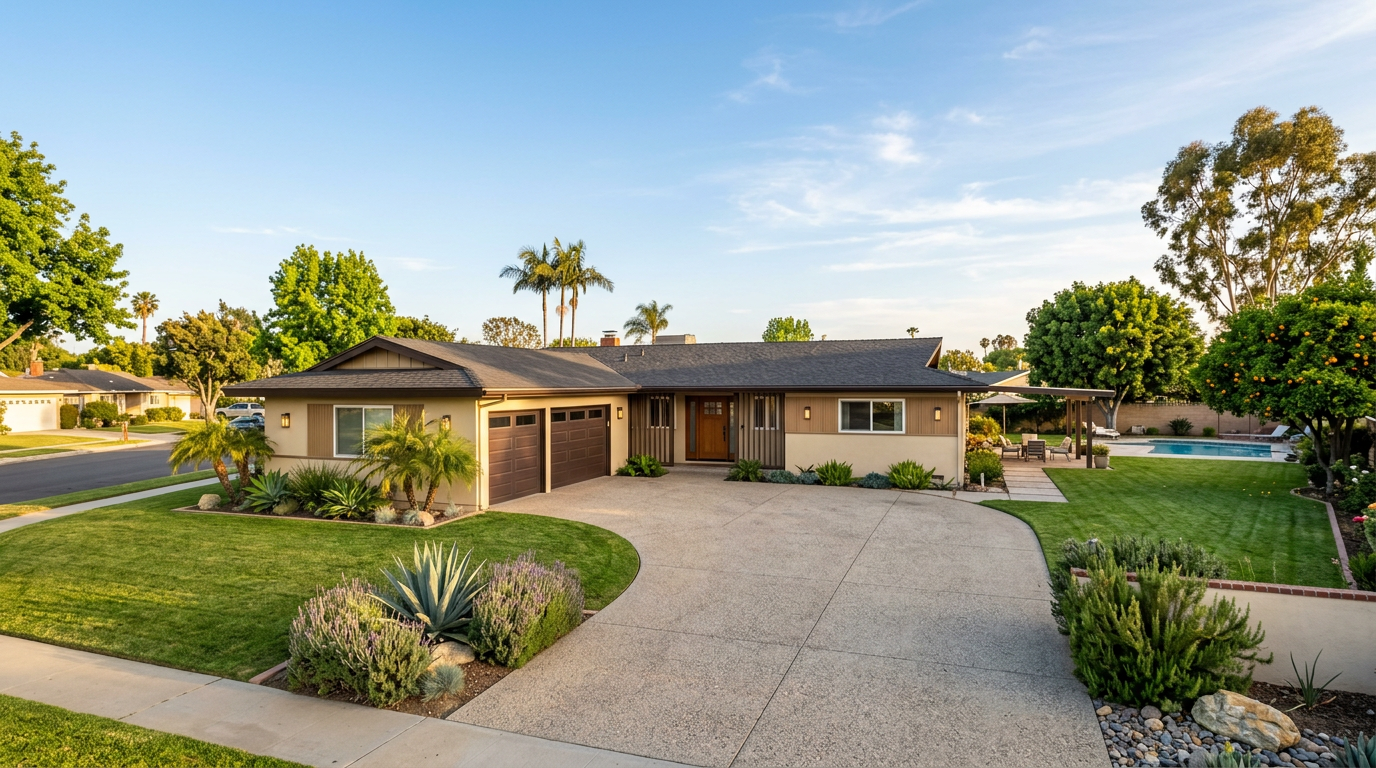
For cash-flow-focused investors, West Anaheim often presents the most compelling math. The post-war tract homes built in the 1950s and 1960s frequently sit on lots exceeding 7,000 square feet, providing the physical space necessary to execute the most popular yield-boosting strategy in California: the ADU.
Maximizing Yield: Anaheim’s ADU Regulations and Potential
Adding an Accessory Dwelling Unit (ADU) is arguably the most powerful tool available to Orange County real estate investors today. By adding a second (or third) rentable unit to a single-family parcel, investors can significantly alter the property's income potential.
While state laws have streamlined ADU permitting across California, local implementation matters. Anaheim has historically been pragmatic about ADU development. For investors, the strategy usually takes one of two forms:
When an investor buys a single-family home that yields a 4% cap rate and adds an ADU, the blended cap rate of the entire property can often push past 5.5% or 6%. Furthermore, properties with legally permitted ADUs command a premium upon resale, providing a strong return on the construction investment.
*Note: Always verify current setback requirements, parking mandates, and utility connection fees directly with the City of Anaheim’s planning department before purchasing a property with the intent to build.*
- The Garage Conversion (JADU/ADU): Converting an existing two-car garage into a 400-square-foot studio or one-bedroom unit. This is the most cost-effective way to add a door, often utilizing existing rooflines and foundations.
- The Detached ADU: Utilizing the deep backyards common in West Anaheim to build a brand-new 800- to 1,000-square-foot, two-bedroom unit.
Small Multifamily (2-4 Units): The Sweet Spot for Financing
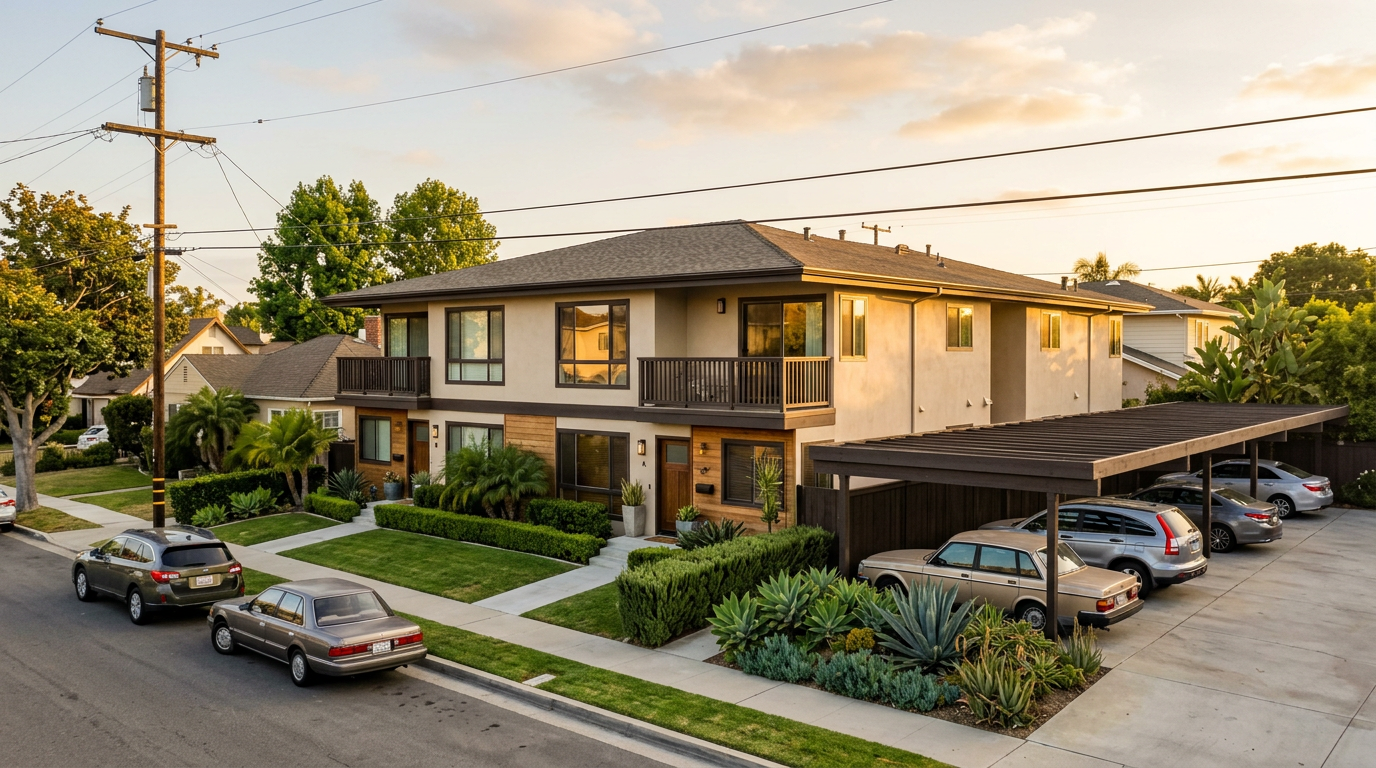
For investors looking to scale beyond single-family homes, Anaheim offers a healthy inventory of duplexes, triplexes, and fourplexes. These small multifamily properties represent a "sweet spot" in real estate investing because they qualify for residential financing rather than commercial financing.
Residential loans typically offer lower interest rates, longer fixed-rate terms (up to 30 years), and more favorable down payment requirements than commercial loans. For an investor utilizing a 1031 exchange, trading out of a highly appreciated single-family home and into an Anaheim fourplex can quadruple the door count and significantly increase monthly cash flow.
Additionally, small multifamily properties in Anaheim are prime targets for "house hacking." An investor can purchase a 2-4 unit property using an FHA or VA loan (which require very low down payments), live in one unit, and rent out the others to offset the mortgage. This is a highly effective strategy for newer investors building a portfolio in Orange County.
Factoring in Carrying Costs: The Anaheim Public Utilities Advantage
One of the most overlooked local details that directly impacts an investor's bottom line is utilities. Unlike most of Orange County, which relies on Southern California Edison (SCE) for electricity, Anaheim has its own city-owned utility provider: Anaheim Public Utilities (APU).
Historically, APU has offered lower electricity and water rates than the larger regional providers. For landlords of multifamily properties who pay for common area electricity, water, and trash, these lower utility costs translate directly into higher Net Operating Income. Even for single-family rentals where tenants pay all utilities, the lower cost of living makes the property more attractive and helps tenants absorb annual rent increases more comfortably.
Beyond utilities, investors must carefully budget for insurance. While Anaheim is generally less exposed to the severe wildfire risks that plague canyon and foothill communities, properties in Anaheim Hills may face stricter underwriting and higher premiums. Always obtain insurance quotes during your escrow contingency period to ensure the carrying costs align with your pro forma.
Short-Term Rentals (STRs) in Anaheim: A Crucial Warning
Because Anaheim is home to Disneyland, out-of-town investors frequently assume the city is a goldmine for short-term rentals (STRs) like Airbnb and VRBO. This is a dangerous assumption that can lead to catastrophic financial mistakes.
In 2016, the City of Anaheim passed strict ordinances essentially banning new short-term rentals in residential zones. The city only permits STRs that were grandfathered in before the ban, or units located in very specific, highly restricted commercial zones.
The city enforces this ban aggressively, utilizing software to scrape listing sites and issuing steep fines to violators. If you are purchasing an investment property in Anaheim, your financial model must be based on mid-term (30+ days) or long-term rental rates. Never purchase a standard residential property in Anaheim expecting to operate it as a nightly vacation rental.
Structuring Your Anaheim Investment Strategy
Successful real estate investing in Orange County requires a long-term perspective and a highly localized strategy. Whether you are executing a 1031 exchange to consolidate your portfolio, searching for a value-add duplex, or looking for a single-family home with the perfect lot for an ADU, the numbers must make sense for your specific financial goals.
It is highly recommended that investors consult with a licensed CPA or tax attorney to understand the tax implications of rental income, depreciation, and capital gains in California.
Navigating the nuances of Anaheim’s neighborhoods, utility zones, and rental demand requires experienced local representation. Paul Phan, Realtor® and the team at The Maison by Phan Group specialize in identifying both on-market and off-market investment opportunities across North Orange County. By analyzing rental comparables, zoning potential, and carrying costs, we help investors make data-driven decisions that build generational wealth.
If you are evaluating an investment property in Anaheim or considering a 1031 exchange within Orange County, contact Paul Phan at The Maison by Phan Group to discuss your portfolio strategy.
Contact The Maison by Phan Group:
- Phone: (714) 717-8088
- Email: paul@maisonbyphan.com
Disclosure
Market information is provided for general education and reflects conditions at the time of writing. It is not legal, tax, or investment advice.
Frequently Asked
What is a good cap rate for an investment property in Anaheim?
In the current market, standard single-family and small multifamily properties in Anaheim typically trade at cap rates between 3.5% and 4.5%. Investors often push these yields higher by executing value-add renovations or building Accessory Dwelling Units (ADUs).
Can I buy a house near Disneyland and use it as an Airbnb?
Generally, no. Anaheim banned new short-term rentals in residential zones in 2016. Unless a property has a grandfathered permit or is located in a specific commercial zone, you cannot legally operate a nightly rental. Long-term or mid-term (30+ days) rentals are required.
Why are lot sizes in West Anaheim good for investors?
Many homes in West Anaheim (zip codes 92801 and 92804) were built in the 1950s and 1960s on lots exceeding 7,000 square feet. These deep backyards provide the necessary space and setbacks to easily accommodate a detached ADU, which significantly increases rental income.
Does Anaheim have its own utility company?
Yes, Anaheim Public Utilities (APU) provides electricity and water to the city. APU's rates have historically been lower than those of larger regional providers like Southern California Edison, which can lower operating costs for property owners.
Talk it through
Have a question about your own situation?
Paul Phan represents buyers and sellers across Orange County — in English and Vietnamese.
(714) 717-8088Continue reading
Buyers
Relocating to Orange County: The Practical Neighborhood Matching Guide
Moving to Orange County requires more than just picking a city on a map. This guide breaks down commute corridors, housing styles, and neighborhood vibes to help relocating buyers find their perfect match.
Buyers
Buying New Construction in North Orange County: Pros, Cons and Negotiation
Purchasing a brand-new home in North Orange County offers modern efficiency and pristine finishes, but the process is vastly different from buying a resale property. Learn how to navigate builder contracts, uncover hidden costs, and negotiate effectively before you step foot in a model home.
Investors
1031 Exchange Strategies: Upgrading Your Orange County Portfolio
Sitting on massive equity but dreading capital gains taxes? Discover how Orange County investors are leveraging the 1031 exchange to upgrade their portfolios and build generational wealth.
