

Buyers · 9 min read
Navigating 2026 Mortgage Rates in Orange County: The Affordability Math
| Paul Phan, Realtor®
Understanding the true cost of homeownership in Orange County goes far beyond the sticker price. We break down the math on mortgage rates, buydowns, and hidden carrying costs for 2026 buyers.
Key Takeaways
- A 1% shift in mortgage rates can alter an Orange County monthly payment by hundreds of dollars.
- Relying on future refinancing ('date the rate') is risky due to closing costs and appraisal requirements.
- Seller concessions for rate buydowns (like a 2-1 buydown) often lower monthly payments more than price reductions.
- HOAs and Mello-Roos in cities like Irvine can add the equivalent of $100,000 in mortgage debt to your monthly carry.
- Buyers must set aside cash reserves for the inevitable Supplemental Tax Bill in their first year of ownership.
The 2026 Interest Rate Reality in Orange County
For buyers navigating the Orange County real estate market in the fall of 2026, interest rates remain the primary driver of affordability. While home prices in highly desirable pockets like Fountain Valley, Westminster, and Irvine have remained resilient, the cost of borrowing has fluctuated, creating a complex landscape for those looking to purchase.
When interest rates shift even by a fraction of a percent, the impact on a high-cost market like Orange County is magnified. A half-point move in the mortgage rate can drastically alter your monthly payment, your debt-to-income ratio, and ultimately, your purchasing power. However, focusing solely on the headline interest rate often obscures the broader financial picture. True affordability encompasses property taxes, Mello-Roos, homeowners association (HOA) dues, and the strategic financing tools available to modern buyers.
At The Maison by Phan Group, we believe that an educated buyer is an empowered buyer. Led by Paul Phan, Realtor®, our goal is to help you move past the anxiety of daily rate fluctuations and focus on the concrete math of homeownership. By understanding the mechanics of rate buydowns, adjustable-rate mortgages, and localized carrying costs, you can build a sustainable, long-term real estate strategy.
The Core Math: How Rates Impact Monthly Payments
To understand the gravity of interest rates in Orange County, it is helpful to look at a hypothetical scenario. Consider a buyer looking at a $1,000,000 single-family home in a community like Garden Grove or Buena Park. Assuming the buyer puts down 20% ($200,000), they will be financing $800,000.
If the prevailing 30-year fixed interest rate is hovering in the mid-6% range, the monthly principal and interest payment alone will be significantly different than if rates were in the mid-5% range. For instance, a 1% difference on an $800,000 loan alters the monthly payment by several hundred dollars. Over the first five years of the loan, that single percentage point represents tens of thousands of dollars in interest.
This mathematical reality dictates buyer behavior. When rates trend upward, buyers often have to pivot their search. A buyer initially looking for a detached home in Costa Mesa might need to shift their focus to a townhome in Santa Ana or Anaheim to keep their monthly payment within their budget. Understanding this math before you begin touring homes prevents the heartbreak of falling in love with a property that does not pencil out in your financial reality.
The Danger of "Date the Rate, Marry the House"
Over the past few years, a popular industry catchphrase has been "date the rate, marry the house." The underlying premise is that buyers should purchase the home they want now, regardless of the current interest rate, with the assumption that they can simply refinance when rates eventually drop.
While this can happen, relying on future refinancing as your primary financial strategy carries substantial risk. Refinancing is not free. It typically costs between 2% and 3% of the loan amount in origination fees, appraisal costs, and title fees. On an $800,000 loan, that can easily amount to $16,000 to $24,000 in closing costs.
Furthermore, refinancing requires the home to appraise at a value that supports the new loan. If the market softens and your home's value dips, you may not have enough equity to refinance without bringing a significant amount of cash to the closing table. Therefore, it is crucial to ensure that you are entirely comfortable with the monthly payment at the time of purchase. If rates drop and you can refinance, consider it a financial bonus, not a prerequisite for your financial survival.
Seller Concessions and Rate Buydowns
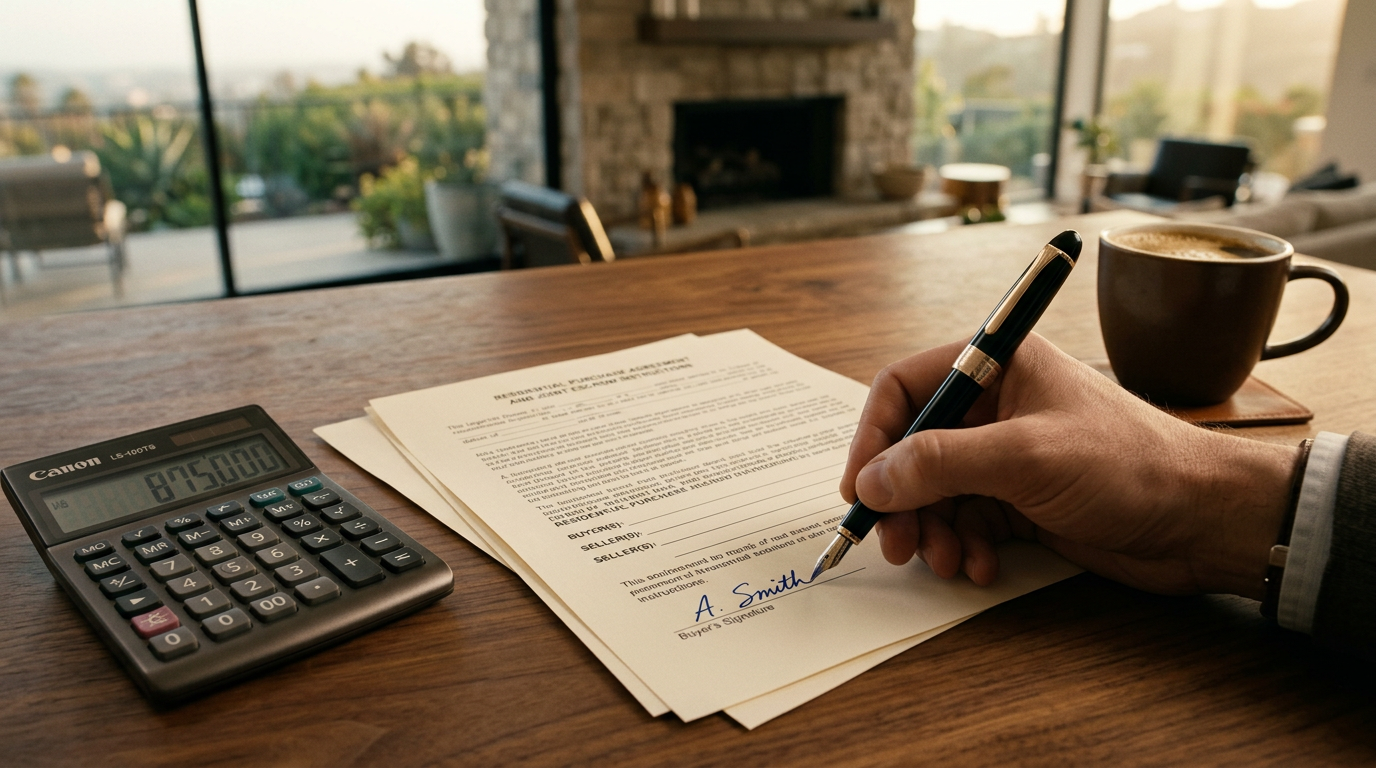
As the Orange County market continues to balance in 2026, buyers have found increased success in negotiating seller concessions. Rather than asking a seller to reduce the purchase price by $15,000, a savvy buyer might ask for a $15,000 credit to be used toward a mortgage rate buydown.
Mathematically, a rate buydown often provides a much larger monthly savings than a corresponding price reduction. There are two primary types of buydowns:
Temporary buydowns are particularly popular for buyers who expect their income to increase in the coming years or who anticipate an opportunity to refinance before the higher rate kicks in. Negotiating these concessions requires a nuanced understanding of the local market—a seller in a highly competitive neighborhood in Newport Beach may reject a buydown request, while a seller in a quieter pocket of North Orange County might welcome it to secure a solid escrow.
- Permanent Buydown: The buyer uses the seller credit to pay "discount points" to the lender, permanently lowering the interest rate for the entire 30-year life of the loan.
- Temporary Buydown (e.g., 2-1 Buydown): The seller credit subsidizes the buyer's interest rate for the first two years of the loan. In a 2-1 buydown, the rate is 2% lower in year one, 1% lower in year two, and returns to the standard fixed rate in year three and beyond.
Adjustable-Rate Mortgages (ARMs) in Orange County
When fixed rates are elevated, Adjustable-Rate Mortgages (ARMs) often make a resurgence. An ARM typically offers a lower initial interest rate for a set period—usually 5, 7, or 10 years—before adjusting annually based on a broader market index.
For example, a 7/1 ARM provides a fixed rate for the first seven years. If you are purchasing a starter condo in Tustin or a multi-unit property in Santa Ana with the explicit plan to move or sell within five to seven years, an ARM can be a highly effective tool. It allows you to secure a lower monthly payment during the years you actually own the home, mitigating the risk of the rate adjusting while you hold the mortgage.
However, ARMs require discipline and clear future planning. If life circumstances change and you are unable to sell or refinance before the introductory period ends, you could face steep increases in your monthly payment. Always ask your lender to map out the "worst-case scenario" adjustment caps so you understand your maximum potential exposure.
Beyond the Mortgage: HOAs and Mello-Roos
In Orange County, the principal and interest payment is only one piece of the affordability puzzle. Buyers must rigorously evaluate local carrying costs, specifically Homeowners Association (HOA) dues and Mello-Roos special assessments.
Consider a buyer comparing two properties priced at $900,000: an older, detached home in Orange and a newer construction townhome in Irvine. The home in Orange may have no HOA and standard property taxes. The Irvine townhome, however, might carry a $350 monthly HOA fee and a Mello-Roos assessment that adds another $300 a month to the tax bill.
That $650 monthly difference in carrying costs is the equivalent of financing roughly $100,000 in additional mortgage debt. Suddenly, the $900,000 Irvine townhome "costs" the same on a monthly basis as a $1,000,000 home without those fees. When running your affordability math, your lender must factor in these specific neighborhood costs to give you an accurate debt-to-income ratio.
High-Balance Conforming vs. Jumbo Loans
Because Orange County is designated as a high-cost area by the Federal Housing Finance Agency (FHFA), buyers benefit from elevated conforming loan limits. In 2026, buyers can finance significantly higher amounts before crossing into "Jumbo Loan" territory compared to buyers in other parts of the country.
Staying within the high-balance conforming limits is often advantageous. Conforming loans generally have more forgiving underwriting guidelines, lower reserve requirements (the amount of cash you must have left in the bank after closing), and sometimes more favorable interest rates.
If you are purchasing a luxury property in coastal cities like Huntington Beach or Newport Beach and require a Jumbo loan, expect stricter scrutiny. Jumbo lenders often require excellent credit scores, lower debt-to-income ratios, and sometimes up to 12 months of mortgage payments in liquid reserves.
Down Payment Realities and PMI
The myth that you must have a 20% down payment to buy a home continues to sideline qualified buyers. In reality, many Orange County buyers utilize conventional loans with 5% or 10% down, or FHA loans with as little as 3.5% down.
Putting down less than 20% typically requires the buyer to pay Private Mortgage Insurance (PMI). While no one enjoys paying for insurance that protects the lender, PMI is often a mathematically sound trade-off. In a market where home values historically appreciate over the long term, waiting five years to save a full 20% down payment might mean watching home prices rise faster than your savings account grows.
For many buyers in cities like Westminster and Little Saigon, paying a few hundred dollars a month in PMI is a worthwhile cost of entry to begin building equity immediately. Furthermore, on conventional loans, PMI can eventually be removed once you reach 20% equity in the property, either through paying down the principal or through the home's natural appreciation.
Property Taxes and the Supplemental Bill Shock
California's Proposition 13 provides incredible long-term stability for homeowners by capping standard property tax increases at 2% per year. However, the initial calculation can catch new buyers off guard. When you purchase a home, the county reassesses the property based on your purchase price, not what the previous owner was paying.
Generally, you should estimate your base property taxes at roughly 1% to 1.2% of the purchase price, plus any local bonds or Mello-Roos.
Crucially, buyers must prepare for the Supplemental Tax Bill. Because it takes the county several months to update their records after a sale, your initial tax bills may still reflect the previous owner's lower tax rate. A few months later, the county will send a supplemental bill to collect the difference between the old tax rate and your new, higher tax rate for that interim period. This bill can be several thousand dollars, and it is rarely paid out of your standard escrow impound account. You must have cash set aside for this expense in your first year of homeownership.
Structuring Your Purchase with The Maison by Phan Group
Running the real numbers on an Orange County home purchase requires a holistic approach. It is not just about finding a house you love; it is about structuring the financing, negotiating the right concessions, and anticipating the carrying costs so that you can live comfortably long after the escrow closes.
This is why assembling the right team is paramount. You need a trusted local lender who understands the nuances of Orange County condo approvals and Jumbo loans. You should consult a qualified CPA to understand how mortgage interest deductions and property taxes impact your specific tax situation. (Note: We are real estate professionals, not CPAs or attorneys; always consult a licensed tax professional for financial advice).
Finally, you need an experienced real estate advisor to negotiate on your behalf. Whether you are seeking a seller-funded rate buydown in Fountain Valley or navigating a multiple-offer scenario in Irvine, Paul Phan and The Maison by Phan Group are here to guide you through the 2026 market.
Ready to run the numbers on your Orange County home search? Contact Paul Phan, Realtor® (DRE #02226917) today at (714) 717-8088 or email paul@maisonbyphan.com to schedule a private buyer consultation.
Disclosure
Market information is provided for general education and reflects conditions at the time of writing. It is not legal, tax, or investment advice.
Frequently Asked
What is a 2-1 mortgage rate buydown?
A 2-1 buydown is a financing strategy where the seller pays a lump sum at closing to lower the buyer's interest rate for the first two years. The rate is reduced by 2% in the first year, 1% in the second year, and returns to the fixed baseline rate in year three.
Do I need a 20% down payment to buy a house in Orange County?
No. Many buyers in Orange County use conventional loans with 5% to 10% down, or FHA loans with 3.5% down. While this requires paying Private Mortgage Insurance (PMI), it allows buyers to enter the market and build equity sooner.
How do Mello-Roos affect my mortgage qualification?
Mello-Roos are special tax assessments common in newer Orange County developments like those in Irvine or South County. Lenders factor this additional monthly cost into your debt-to-income ratio, which can reduce the total loan amount you qualify for.
Is it safe to get an Adjustable-Rate Mortgage (ARM) right now?
An ARM can be a smart strategy if you have a definitive plan to sell or refinance before the fixed introductory period (usually 5 or 7 years) expires. However, they carry the risk of higher payments if rates rise and you are unable to exit the loan before it adjusts.
Talk it through
Have a question about your own situation?
Paul Phan represents buyers and sellers across Orange County — in English and Vietnamese.
(714) 717-8088Continue reading
Investors
The Orange County Rental Market: Should You Sell or Keep and Rent?
Record-low mortgage rates have turned many Orange County homeowners into accidental landlords. But does keeping your property as a rental actually make financial sense in 2026?
Market
Irvine vs. Tustin: Schools, HOAs, and Long-Term Value in 2026
Choosing between Irvine and Tustin requires looking past the purchase price. We break down the true carrying costs, school district nuances, and long-term appreciation trends for Orange County families.
Buyers
The Vietnamese-American Guide to Multigenerational Homebuying in OC
For many Vietnamese-American families in Orange County, multigenerational living is both a cultural cornerstone and a strategic financial move. Discover how to navigate floor plans, ADUs, and joint financing to secure a home that comfortably houses every generation.
