
Market · 8 min read
Old Towne Orange Historic District: Landmark Homes and Buying Rules
| Paul Phan, Realtor®
Purchasing a home in the Old Towne Orange Historic District offers a rare slice of preserved California history. However, buyers must navigate strict design guidelines, unique property tax benefits, and the realities of century-old architecture.
Key Takeaways
- Old Towne Orange features the largest concentration of historic buildings in California, dominated by Craftsman bungalows.
- Exterior modifications require city design review to preserve historical accuracy, down to windows and paint colors.
- The Mills Act can offer substantial property tax savings for historic homes, and these contracts transfer to new buyers.
- Chapman University brings cultural benefits but requires buyers to evaluate block-by-block noise and parking realities.
- Specialized inspections are critical for century-old homes to check foundations, knob-and-tube wiring, and cast iron plumbing.
The Heart of Orange County’s Heritage
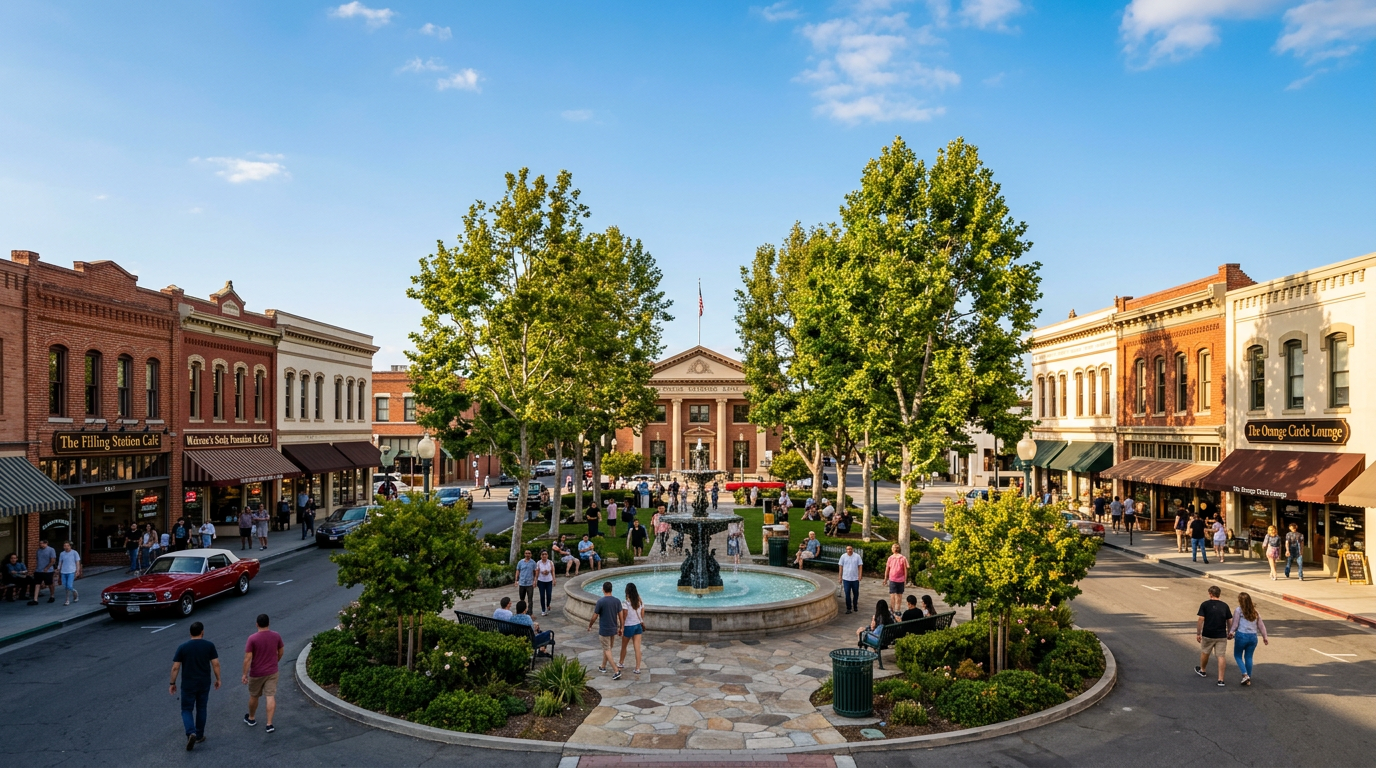
At the intersection of Glassell Street and Chapman Avenue lies the Plaza, the geographic and cultural epicenter of the Old Towne Orange Historic District. Unlike the master-planned communities that define much of modern Orange County, Old Towne offers a genuine step back in time. Established in the late 19th century and placed on the National Register of Historic Places in 1997, this roughly one-square-mile area contains the largest concentration of historic buildings in California.
For residents, daily life revolves around this iconic roundabout. Weekends mean walking to Watson’s Soda Fountain, browsing the antique malls that line Glassell, or grabbing coffee at Portola before heading to the weekly farmers market. But beyond the commercial core lies a sprawling, grid-patterned residential neighborhood that fiercely protects its architectural heritage. Buying a home here is not just a real estate transaction; it is an assumption of stewardship. For those drawn to the wide front porches, mature Moreton Bay fig trees, and tight-knit community feel, Old Towne Orange is an unparalleled place to call home.
Architectural Styles and Block-by-Block Character
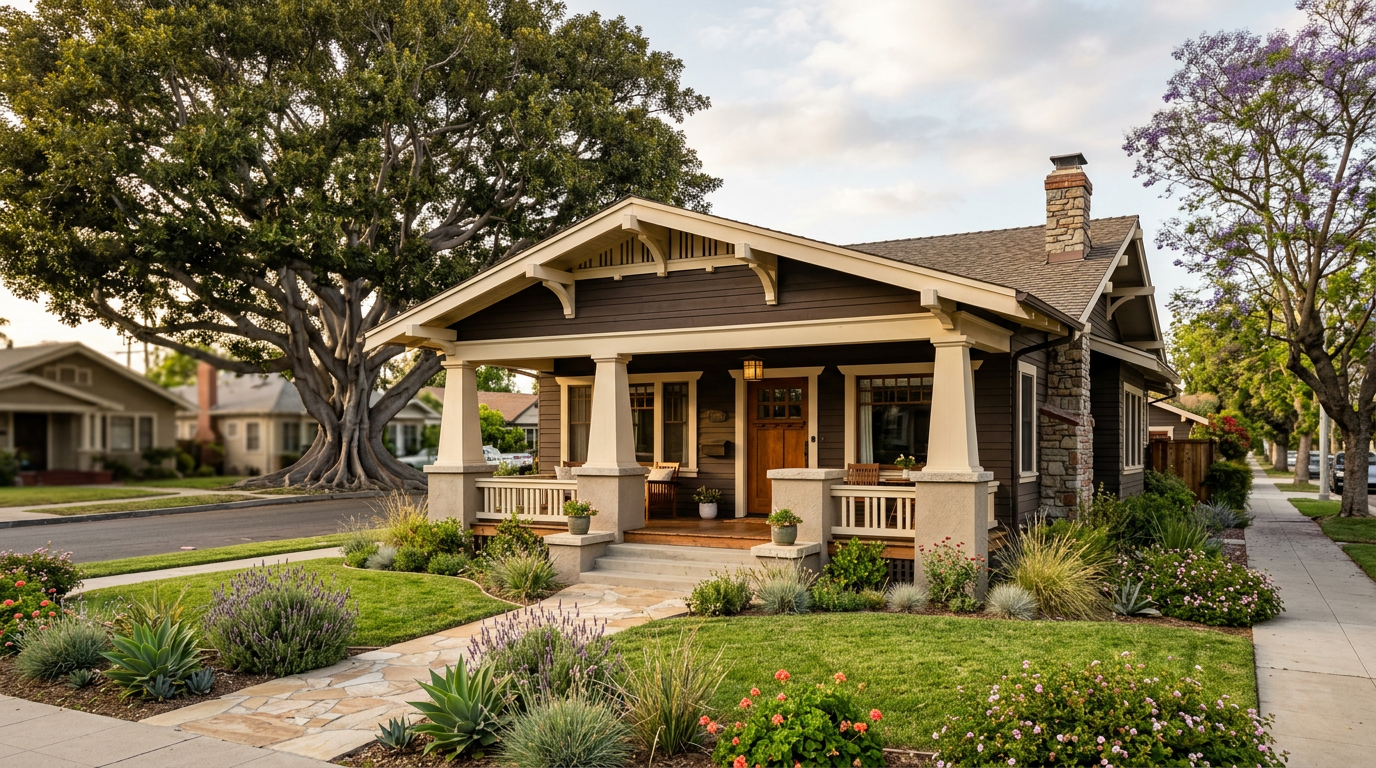
The residential streets radiating from the Plaza—such as Shaffer, Grand, Olive, and Center—are living museums of early 20th-century American architecture. The district boasts over 1,300 historic structures, with the California Craftsman bungalow being the most prevalent. These homes are characterized by their low-pitched roofs, exposed rafter tails, built-in cabinetry, and expansive front porches designed for socializing with neighbors.
However, the architectural diversity extends well beyond the Craftsman style. Buyers will also find stunning examples of Queen Anne Victorians with their ornate woodwork and asymmetrical facades, Spanish Colonial Revivals featuring stucco walls and red clay tile roofs, and Prairie-style homes that emphasize horizontal lines.
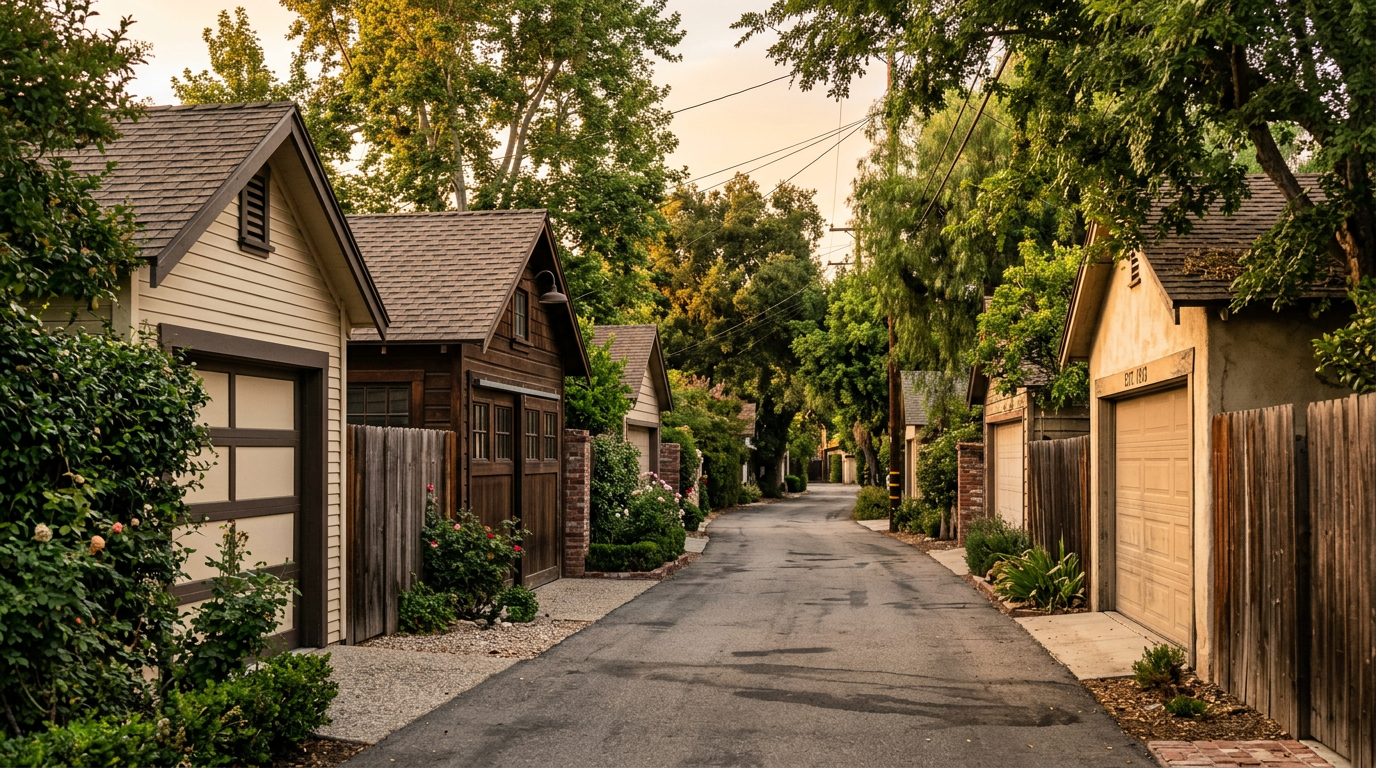
The layout of the neighborhood is a traditional grid, a stark contrast to the cul-de-sacs of South County. Alleys run behind many of the homes, providing access to detached garages (historically carriage houses). This alley system keeps the streetscapes remarkably clean, free of the curb cuts and front-facing garage doors that dominate modern suburbs.
Real Estate Realities and Price Bands
Because inventory is strictly limited to what was built a century ago, demand for homes in Old Towne Orange consistently outpaces supply. Buyers pay a premium for the historic charm, walkability, and community prestige.
In recent months, a heavy fixer-upper—perhaps a smaller two-bedroom bungalow needing comprehensive system updates—can still command prices approaching the $850,000 to $1,000,000 range, largely due to land value and location. Move-in ready historic homes typically range from $1.1 million to $1.5 million. For fully restored, historically accurate masterpieces on larger lots, or expansive Victorians with preserved original millwork, prices frequently push well beyond the $1.8 million mark.
Buyers should note that price per square foot in Old Towne is often significantly higher than in the standard tract neighborhoods of East Orange or neighboring Villa Park. You are paying for the irreplaceable character, the proximity to the Plaza, and often, the tax benefits associated with historic preservation.
The Rules of Historic Preservation
Owning a home in Old Towne Orange means adhering to the City of Orange’s strict Historic Preservation Design Standards. This is not a neighborhood where you can freely modernize an exterior on a whim. The city's objective is to maintain the visual integrity of the streetscape as it appeared in the 1920s.
If you purchase a contributing historic structure, any exterior modifications visible from the public right-of-way must undergo a design review process. This includes replacing windows, altering front porches, changing siding, or adding square footage. For example, replacing original wood-sash windows with modern white vinyl is almost universally prohibited. If a window must be replaced, it typically must be custom-milled wood to match the original profile.
Even paint colors are subject to scrutiny, with the city strongly encouraging historically appropriate palettes. While these regulations can sometimes frustrate homeowners looking for a quick renovation, they are precisely what protects the neighborhood's charm and, by extension, its property values. Buyers must factor in the time and cost of working with contractors who specialize in historic compliance.
The Mills Act: Property Tax Benefits
One of the most significant financial advantages of buying a historic home in California is the Mills Act, and Old Towne Orange has one of the most active Mills Act programs in the state.
The Mills Act is an economic incentive program that allows cities to enter into contracts with private property owners. In exchange for a commitment to actively preserve and maintain the historic property, the owner receives a substantial reduction in their property taxes. Instead of being taxed on the purchase price (Proposition 13), the property is reassessed using an income-capitalization method, which often results in property tax savings of 40% to 60%.
For buyers, there are a few critical realities to understand:
For older buyers looking to downsize into a historic home, Proposition 19 may also offer the ability to transfer an existing low property tax base from a previous primary residence in California. Because property tax laws are complex and highly individualized, we strongly advise consulting with a qualified CPA or real estate attorney to understand how the Mills Act and Prop 19 apply to your specific financial situation.
- It Transfers: If a home already has a Mills Act contract, that contract (and the tax savings) transfers to the new buyer upon closing.
- It is Not Guaranteed: If a home does not have a contract, you can apply for one, but the city only grants a limited number each year, and the property must meet strict restoration criteria.
- The Commitment: The tax savings are meant to be reinvested into the home’s preservation. The city conducts periodic inspections to ensure compliance.
ADUs, Additions, and Modern Living
A common question from buyers is whether they can build an Accessory Dwelling Unit (ADU) on a historic lot or add square footage to accommodate a modern family. The short answer is yes, but with distinct caveats.
Under state law, ADUs are permitted, but in Old Towne, they must be designed to be subordinate to the main historic structure. They are typically required to be placed at the rear of the property, often utilizing the alley access. The architectural style, roof pitch, siding, and windows of the ADU must harmonize with the primary residence. Many homeowners choose to convert or rebuild their historic carriage houses into ADUs, providing excellent rental income or multi-generational living space without disrupting the historic streetscape.
For primary home additions, the new construction must be distinguishable from the historic structure (so as not to create a false sense of history) yet compatible in massing and scale. "Pop-ups" or second-story additions on single-story bungalows are notoriously difficult to get approved and are highly discouraged by the design guidelines.
The Chapman University Factor
It is impossible to discuss real estate in Old Towne Orange without discussing Chapman University. The campus is seamlessly integrated into the neighborhood, sitting just a few blocks north of the Plaza.
Chapman is a tremendous cultural asset, offering residents access to beautiful, walkable grounds, the Musco Center for the Arts, and a vibrant collegiate atmosphere. However, it also introduces specific neighborhood dynamics. The influx of students means that certain blocks have a high concentration of student rentals.
For buyers, this translates to two main considerations: parking and noise. The city has implemented permit parking on many residential streets to ensure homeowners can park near their houses. Additionally, the city enforces strict "party house" ordinances to maintain neighborhood tranquility. When evaluating a home in Old Towne, we always recommend that buyers visit the specific block at different times—a Tuesday evening, a Friday night, and a Saturday afternoon—to get a true feel for the immediate micro-neighborhood.
Commutes, Transit, and Connectivity
Despite its historic isolation, Old Towne Orange is exceptionally well-connected. The neighborhood is bordered by the 22 freeway to the south, the 57 freeway to the west, and the 55 freeway to the east, making commutes to Irvine, Anaheim, or Los Angeles highly accessible.
Perhaps the greatest transit asset is the Orange Metrolink Station, located just a few blocks west of the Plaza. Housed in a charming depot, the station provides direct rail access to Union Station in Los Angeles, south to San Juan Capistrano and Oceanside, and inland to Riverside. For professionals who work in Downtown LA but want the charm of a historic suburb, the ability to walk from a Craftsman bungalow to the train station is a rare and highly sought-after luxury in Southern California.
Inspections and Buying Strategy
Buying a 100-year-old home requires a specialized approach to due diligence. Standard home inspections are necessary, but buyers must be prepared for the realities of century-old construction.
Key areas of focus include:
Navigating these inspections, understanding the cost of historic compliance, and negotiating repairs requires representation that understands the specific nuances of Old Towne. At The Maison by Phan Group, led by Paul Phan, Realtor®, we help buyers assess the true condition of historic properties, connect them with specialized inspectors, and ensure they understand the exact boundaries and rules of the district before making an offer.
If you are considering purchasing a piece of Orange County history, or if you are looking to sell a landmark property, having an experienced guide is essential. Contact Paul Phan at (714) 717-8088 or paul@maisonbyphan.com to discuss your real estate goals in Old Towne Orange.
- Foundations: Many original homes were built on raised foundations with unreinforced masonry or river rock. Buyers should assess the need for seismic retrofitting (bolting the house to the foundation and reinforcing cripple walls).
- Electrical: While many homes have been updated, inspectors must look for remnants of active knob-and-tube wiring, which can pose fire hazards and complicate home insurance.
- Plumbing: Original cast iron sewer lines and galvanized steel water pipes often require replacement if they have not been updated in recent decades.
Disclosure
Market information is provided for general education and reflects conditions at the time of writing. It is not legal, tax, or investment advice.
Frequently Asked
Can I build an ADU in the Old Towne Orange Historic District?
Yes, ADUs are permitted under state law, but they must comply with the city's historic design standards. They typically must be placed at the rear of the lot, often utilizing alley access, and must match the architectural style of the primary historic home.
What is the Mills Act and how does it affect property taxes?
The Mills Act is a state program that allows cities to offer significant property tax reductions to owners of historic properties who commit to preserving them. If a home already has a Mills Act contract, the tax benefits and preservation obligations transfer to the new buyer.
Are there restrictions on what colors I can paint my historic home?
Yes, the City of Orange strongly encourages historically accurate paint palettes for homes within the historic district. While exact rules vary based on the home's specific designation, exterior changes visible from the street generally require city review.
How does Chapman University impact the local real estate market?
Chapman University increases demand for rentals and adds cultural vibrancy to the area, but it also brings student-related parking and noise. The city manages this through strict residential permit parking zones and noise ordinances, making block-by-block evaluation essential for buyers.
Talk it through
Have a question about your own situation?
Paul Phan represents buyers and sellers across Orange County — in English and Vietnamese.
(714) 717-8088Continue reading
Market
Homes Around Mile Square Park: Fountain Valley Neighborhoods
Mile Square Regional Park is the 607-acre crown jewel of Fountain Valley, offering residents an unparalleled outdoor lifestyle right in their backyards. For homebuyers, navigating the neighborhoods that border this massive green space requires understanding hyper-local traffic patterns, school boundaries, and architectural nuances.
Market
Irvine Unified vs. Tustin Unified: The Real Estate Boundary Guide
In Orange County, an invisible line separates the Irvine and Tustin school districts, often running right through the middle of residential neighborhoods. Understanding how this boundary impacts home prices, property taxes, and daily commutes is essential for buyers navigating the local market.
Market
Huntington Beach High School Boundaries: A Coastal Real Estate Guide
For families moving to Huntington Beach, navigating high school boundaries is just as critical as finding the right coastal home. Discover the neighborhoods, housing styles, and local real estate nuances surrounding the city's major high school campuses.
