

Buyers · 8 min read
Reading the Fine Print: OC HOAs, Mello-Roos & Assessments
| Paul Phan, Realtor®
The sticker price of an Orange County home is only part of the financial equation. Understanding the fine print of HOAs, Mello-Roos, and reserve studies is essential to protecting your long-term budget.
Key Takeaways
- Orange County property taxes usually exceed the 1% Prop 13 base due to local bonds and direct assessments.
- Mello-Roos (CFD) taxes are common in newer master-planned communities like Irvine and Tustin Legacy, but they eventually expire.
- An HOA reserve study is your best tool for predicting future costs; funding levels below 30% indicate a high risk for special assessments.
- The 2025 deadline for California's 'Balcony Bill' (SB 326) means many older OC condo complexes are issuing special assessments in 2026 to fund repairs.
- Always read the past 12 months of HOA board meeting minutes to spot arguments over budgets, deferred maintenance, or upcoming litigation.
Anatomy of an Orange County Property Tax Bill
Before writing an offer, you must understand how property taxes are calculated for that specific parcel. California’s Proposition 13 caps general property taxes at 1% of the assessed value, with annual increases limited to 2%. However, your actual tax bill in Orange County will almost always be higher than a flat 1%.
When you look up a property on the Orange County Treasurer-Tax Collector’s portal, you will see the bill divided into two main sections:
In older, established cities like Westminster, Fountain Valley, or Santa Ana, your total tax rate will generally hover between 1.05% and 1.2%. In newer master-planned communities, these direct assessments can push your effective tax rate closer to 1.5% or even 1.8%.
- The Basic Levy: This is the standard 1% tax rate based on the assessed value of the home.
- Direct Assessments and Voted Indebtedness: These are additional charges for local school bonds, water districts, vector control, and, most notably, Mello-Roos.
Mello-Roos (Community Facilities Districts) Demystified
Mello-Roos taxes—officially known as Community Facilities Districts (CFDs)—were created in the 1980s as a workaround to Prop 13. When developers build new communities, they partner with local governments to issue municipal bonds to pay for new infrastructure: schools, roads, parks, and fire stations. The homeowners in that specific district pay off these bonds over time through their property tax bills.
Where You Will Find Them: Mello-Roos are ubiquitous in newer master-planned communities. If you are looking at the Villages of Irvine (like Portola Springs or Great Park Neighborhoods), Tustin Legacy, or newer developments in Brea and Yorba Linda, you should expect to see CFDs. Conversely, if you are buying a 1960s tract home in Costa Mesa, Anaheim, or Garden Grove, you are highly unlikely to encounter Mello-Roos.
The Expiration Date: A common misconception is that Mello-Roos taxes last forever. In reality, the bonds that fund these districts have a maturity date, typically ranging from 25 to 40 years from the date they were issued. When reviewing a property, you can contact the specific district administrator (listed on the tax bill) to find out exactly when the bond matures and the tax falls off.

The 2026 HOA Landscape: Why Dues Are Rising
HOA dues in Orange County have seen significant upward pressure in recent years. If you are returning to the condo or townhome market after a few years away, you may be surprised to see monthly dues ranging from $400 to over $800 in communities that previously charged much less.
Three primary factors are driving these increases in 2026:
- The Master Insurance Crisis: California's insurance market has undergone massive changes. HOAs, particularly those in wildfire-adjacent zones like Anaheim Hills, Orange, and parts of South County, have seen their master policy premiums skyrocket. These costs are passed directly to homeowners through higher monthly dues.
- Inflation on Materials and Labor: The cost to repave a private street, replace a community roof, or maintain a pool has increased substantially.
- Deferred Maintenance: Many older HOAs kept dues artificially low for decades to appease homeowners, resulting in severely underfunded reserves that must now be replenished rapidly.
Reading the Reserve Study: Your Financial Crystal Ball
During the escrow process, the seller is legally required to provide you with the HOA disclosure package. The single most important document in this stack is the Reserve Study.
By law, California HOAs must conduct a reserve study every three years to estimate the remaining useful life of major components (roofs, asphalt, pool pumps, exterior paint) and calculate how much money needs to be in the bank to replace them when they fail.
The key metric to look for is the Percent Funded. This tells you how much cash the HOA actually has compared to what the study says they *should* have.
If you are buying into a 1970s condo complex in Huntington Beach with original plumbing and a reserve fund sitting at 15%, you must factor the likelihood of a massive upcoming bill into your purchase price.
Special Assessments and the "Balcony Bill" Aftermath
A special assessment is a one-time charge levied by the HOA to cover a major, unexpected expense that the reserve fund cannot handle. These can range from $1,000 for minor repairs to $30,000+ per unit for complete roof replacements or structural work.
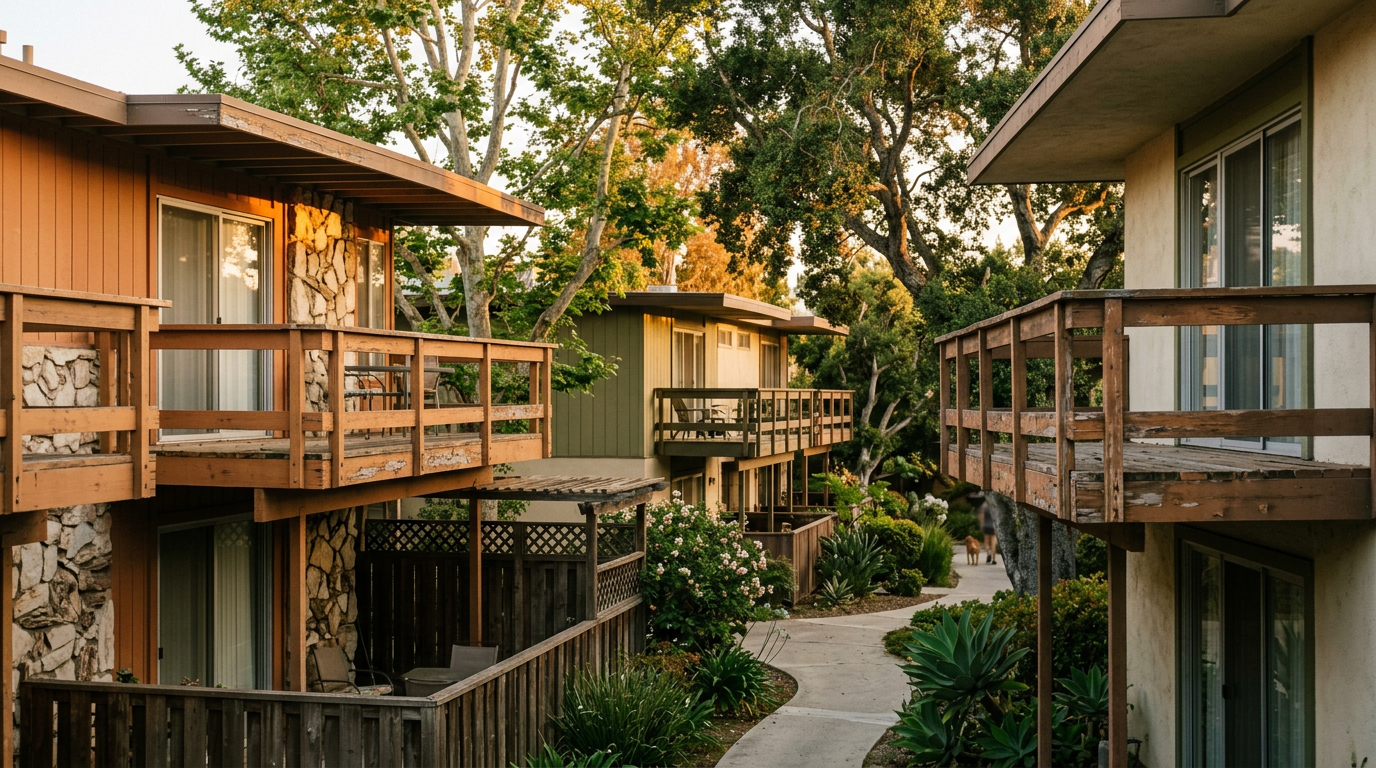
In 2026, the ripple effects of California Senate Bill 326 (the "Balcony Bill") are still being felt. This law required all condos with three or more units to have their exterior elevated elements (balconies, walkways, decks) inspected by a structural engineer by January 1, 2025.
Now that the inspections are complete, many older, wood-framed complexes in cities like Anaheim, Costa Mesa, and Santa Ana are facing the actual repair bills. When reviewing HOA documents, you must read the last 12 months of Board Meeting Minutes. Look for keywords like "structural repairs," "SB 326 compliance," "litigation," or "shortfall." If the board is arguing about how to pay for balcony repairs, a special assessment is likely on the horizon.
Master vs. Sub-Associations
In many of Orange County’s master-planned communities, you aren't just joining one HOA—you are joining two.
For example, if you buy a townhome in certain villages of Irvine or Ladera Ranch, you will pay a Master Association fee (which maintains the large community parks, trails, and major amenities) and a Sub-Association fee (which maintains the roof, exterior, and private gates of your specific townhome tract).
When applying for a mortgage, your lender will factor *both* of these dues into your Debt-to-Income (DTI) ratio. It is crucial to have your lender run your pre-approval using the exact total HOA dues for the property you are targeting, as an unexpected $200 monthly sub-association fee can be enough to derail a loan approval.
Red Flags in the CC&Rs
The Covenants, Conditions, and Restrictions (CC&Rs) are the legally binding rules of the community. While they are often hundreds of pages long, buyers must review them carefully to ensure the community aligns with their lifestyle and long-term plans.
Key areas to scrutinize include:
- Rental Restrictions: Many HOAs cap the number of units that can be rented at any given time (e.g., no more than 20% of the complex). If you plan to live in the property for a few years and then convert it to an investment property, a rental cap could ruin your strategy.
- Parking Rules: In dense areas of Garden Grove or Anaheim, street parking is at a premium. Check the CC&Rs for rules on overnight guest parking, commercial vehicle bans, and whether you are required to park your cars in the garage rather than using it for storage.
- Pet Limits: It is common for HOAs to restrict the number of pets (often a maximum of two) and sometimes impose weight limits or breed restrictions.
Building Your Due Diligence Team
Navigating the disclosures, tax records, and reserve studies of an Orange County property requires a methodical approach. During your escrow contingency period—typically 17 days for disclosures under the standard California Association of REALTORS® purchase agreement—you have the right to review all of these documents and back out of the deal without penalty if you discover a financial red flag.
This is where experienced representation is vital. Paul Phan and the team at The Maison by Phan Group routinely help buyers map out these exact carrying costs before a single offer is drafted. By identifying underfunded HOAs and calculating exact Mello-Roos impacts early, buyers can avoid getting trapped in escrow on a home that ultimately breaks their monthly budget.
*(Note: Real estate professionals can help you identify and gather these documents, but for specific interpretations of tax liabilities or legal restrictions, you should always consult a licensed CPA or real estate attorney.)*
The Path Forward
HOAs and Mello-Roos are not inherently bad; in fact, they are the reason many Orange County neighborhoods maintain their pristine landscaping, excellent schools, and high property values. The goal is not to avoid them entirely, but to underwrite them correctly.
By taking the time to read the fine print, analyze the reserve study, and understand your total tax burden, you can purchase your Orange County home with absolute financial confidence.
*
*Navigating the complexities of Orange County real estate requires a strategic partner. Contact Paul Phan, Realtor® (DRE #02226917) and The Maison by Phan Group at (714) 717-8088 or paul@maisonbyphan.com to discuss your homebuying strategy.*
Disclosure
Market information is provided for general education and reflects conditions at the time of writing. It is not legal, tax, or investment advice.
Frequently Asked
What is a good reserve funding percentage for an HOA?
A reserve fund is generally considered strong if it is 70% to 100% funded. Levels between 31% and 70% are considered moderate, while anything below 30% is weak and puts homeowners at a high risk for sudden special assessments.
Can Mello-Roos taxes be paid off early?
In some communities, yes. Certain Community Facilities Districts allow homeowners to pay off their portion of the Mello-Roos bond in a lump sum. You must contact the specific district administrator listed on your tax bill to find out if this is an option and request a payoff quote.
How long do I have to review HOA documents during escrow?
Under the standard California residential purchase agreement, buyers typically have 17 days to review all disclosures, including the HOA package. However, this timeline can be negotiated in the contract, and the clock starts after the seller delivers the complete set of documents.
Do single-family homes in Orange County have HOAs?
It depends on the city and the neighborhood. Older tract homes in cities like Garden Grove, Westminster, and Anaheim rarely have HOAs. However, most single-family homes built after 1980 in master-planned communities like Irvine, Aliso Viejo, or newer parts of Huntington Beach will have an HOA.
Talk it through
Have a question about your own situation?
Paul Phan represents buyers and sellers across Orange County — in English and Vietnamese.
(714) 717-8088Continue reading
Market
The New OC Carrying Costs: Solar, Insurance & Utilities in 2026
Mortgage rates dominate the headlines, but the true cost of Orange County homeownership is shifting. Here is how rising insurance premiums, new solar regulations, and utility hikes are reshaping your monthly carrying costs.
Investors
Anaheim Investment Property: Rents, Cap Rates and ADU Potential
Anaheim offers a unique blend of strong tenant demand and favorable lot sizes for investors. Discover how ADUs, local utility advantages, and neighborhood selection impact cap rates in this North Orange County hub.
Buyers
Relocating to Orange County: The Practical Neighborhood Matching Guide
Moving to Orange County requires more than just picking a city on a map. This guide breaks down commute corridors, housing styles, and neighborhood vibes to help relocating buyers find their perfect match.
