
Market · 10 min read
Great Park Irvine: Navigating Homes Near OC's Largest Landmark
| Paul Phan, Realtor®
Irvine's Great Park has transformed from a historic Marine base into Orange County's premier destination for sports, education, and modern housing. For homebuyers, living near this massive landmark offers unparalleled amenities, but requires navigating premium pricing, high-density designs, and complex tax structures.
Key Takeaways
- The Great Park is a 1,300-acre landmark featuring world-class sports facilities, ice rinks, and ongoing master-planned development.
- Housing density is high, with many homes featuring three-story layouts, minimal private yards, and extensive shared community amenities.
- IUSD K-8 schools are integrated directly into the neighborhoods, though buyers must verify capacity and potential overflow policies.
- Mello-Roos assessments and dual HOAs are standard, significantly impacting monthly carrying costs and debt-to-income ratios.
- Proximity to regional attractions means residents must navigate weekend tournament traffic and ongoing construction in undeveloped park phases.
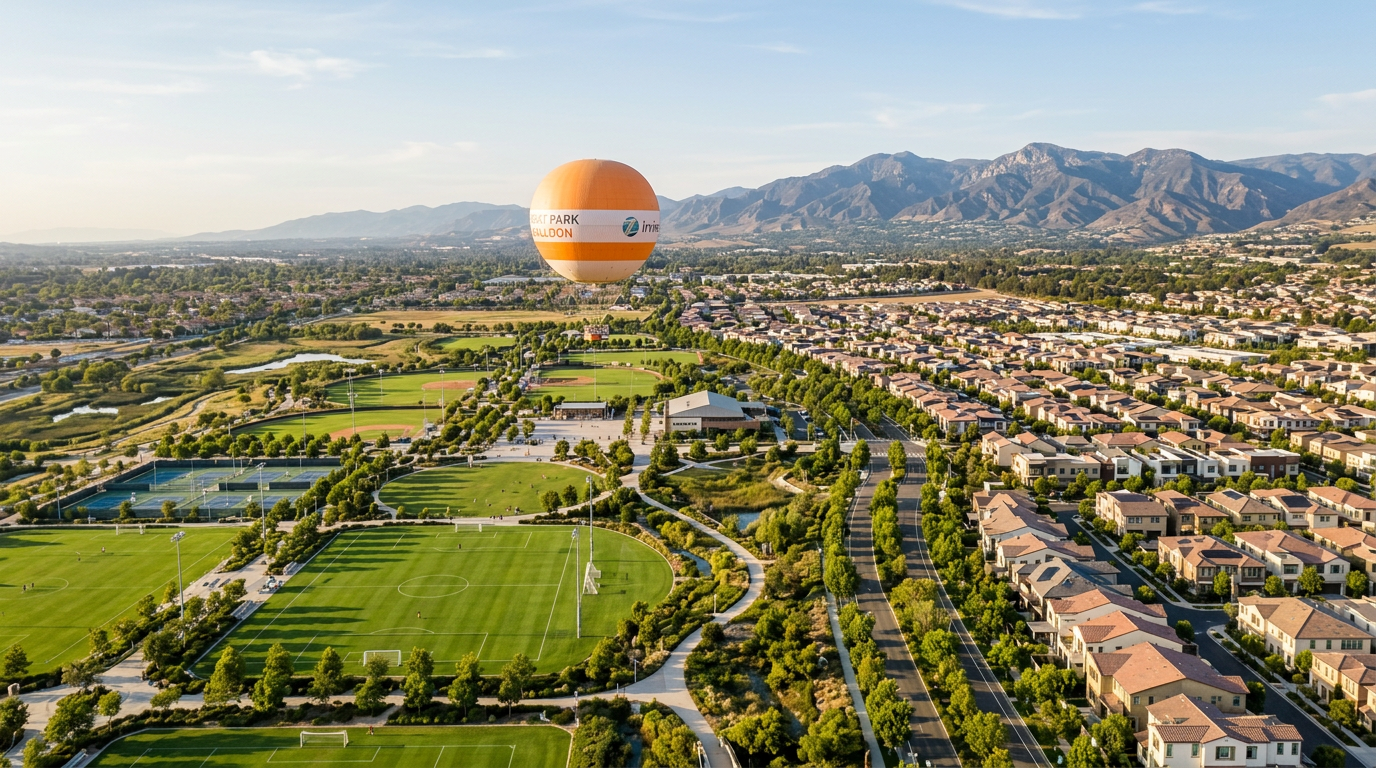
If you drive south on the 5 Freeway through central Orange County, it is impossible to miss: a massive, bright orange balloon tethered 400 feet in the air. For years, this balloon was the solitary marker of a promise—the transformation of the decommissioned El Toro Marine Corps Air Station into one of the largest municipal parks in the United States. Today, the Great Park in Irvine is no longer just a promise. It is a sprawling, multi-billion-dollar reality of sports complexes, cultural spaces, top-tier schools, and a perimeter of highly sought-after residential neighborhoods.
For homebuyers looking at Irvine, the Great Park Neighborhoods represent the newest, most modern housing stock in the city. But buying a home here is fundamentally different from purchasing in older, established Irvine villages like Woodbridge or Turtle Rock. Here, you are not just buying into a quiet subdivision; you are buying into a regional landmark.
Understanding how the park's amenities, the integrated Irvine Unified School District (IUSD) campuses, and the dense housing architecture all interact is critical. As a senior market editor for The Maison by Phan Group, I regularly speak with buyers who are drawn to the pristine parks and modern designs, but who need a clear-eyed view of the traffic, the Mello-Roos taxes, and the reality of living next to a regional tourist destination.
The Evolution of a Landmark
The footprint of the Great Park is staggering. Spanning roughly 1,300 acres, the park itself is larger than New York's Central Park. It sits roughly bordered by Irvine Boulevard to the north, the 133 Toll Road to the east, the 5 Freeway to the south, and Sand Canyon Avenue to the west.
The development has been phased over many years, transitioning from the historic runways of the El Toro base into distinct zones. The central core remains public parkland owned by the City of Irvine, while the perimeter is being developed into a series of residential "collections" by FivePoint Holdings and various homebuilders.
For residents, this means the landscape is dynamic. While vast portions of the park are complete and bustling with activity, other sections are still active construction zones as the city pushes forward with plans for botanical gardens, a permanent amphitheater, and retail spaces. Buyers moving into the area must be comfortable with the ongoing evolution of the master plan.
A Landmark Built for Sports and Recreation
The defining characteristic of the Great Park today is its unparalleled sports infrastructure. It has become a premier destination for youth, collegiate, and professional athletics, which heavily influences the lifestyle of the surrounding neighborhoods.
The Great Park Sports Complex spans 194 acres and includes a 2,500-seat Championship Soccer Stadium, a massive tennis complex, and dozens of baseball, softball, and soccer fields. Adjacent to this is Great Park Ice & FivePoint Arena, a state-of-the-art, 260,000-square-foot facility with four sheets of ice. It serves as the official practice facility for the Anaheim Ducks and a hub for figure skating and youth hockey leagues across Southern California.
Adding to the recreational draw is Wild Rivers, the massive water park that returned to Irvine and opened within the Great Park footprint.
For homeowners in the immediate vicinity, these amenities are a double-edged sword. On a Tuesday evening, residents have world-class walking trails, expansive lawns, and the Palm Court Arts Complex practically to themselves. On a Saturday morning during a regional soccer tournament, however, the main arteries—Marine Way, Ridge Valley, and Great Park Boulevard—can become congested with visitors from across the state. Living here means sharing your neighborhood with the rest of Orange County.
The Great Park Neighborhoods: A Unique Master Plan
The residential footprint surrounding the park is divided into distinct neighborhoods, often referred to as "parks" or "collections." These include Pavilion Park (the first to open), Beacon Park, Parasol Park, Cadence Park, Novel Park, Solis Park, and Luna Park.
Each neighborhood was designed with a central community hub—often featuring resort-style pools, clubhouses, outdoor kitchens, and unique playgrounds. The design philosophy heavily favors shared community spaces over private yards.
Irvine Unified Schools: Campuses Woven into the Fabric
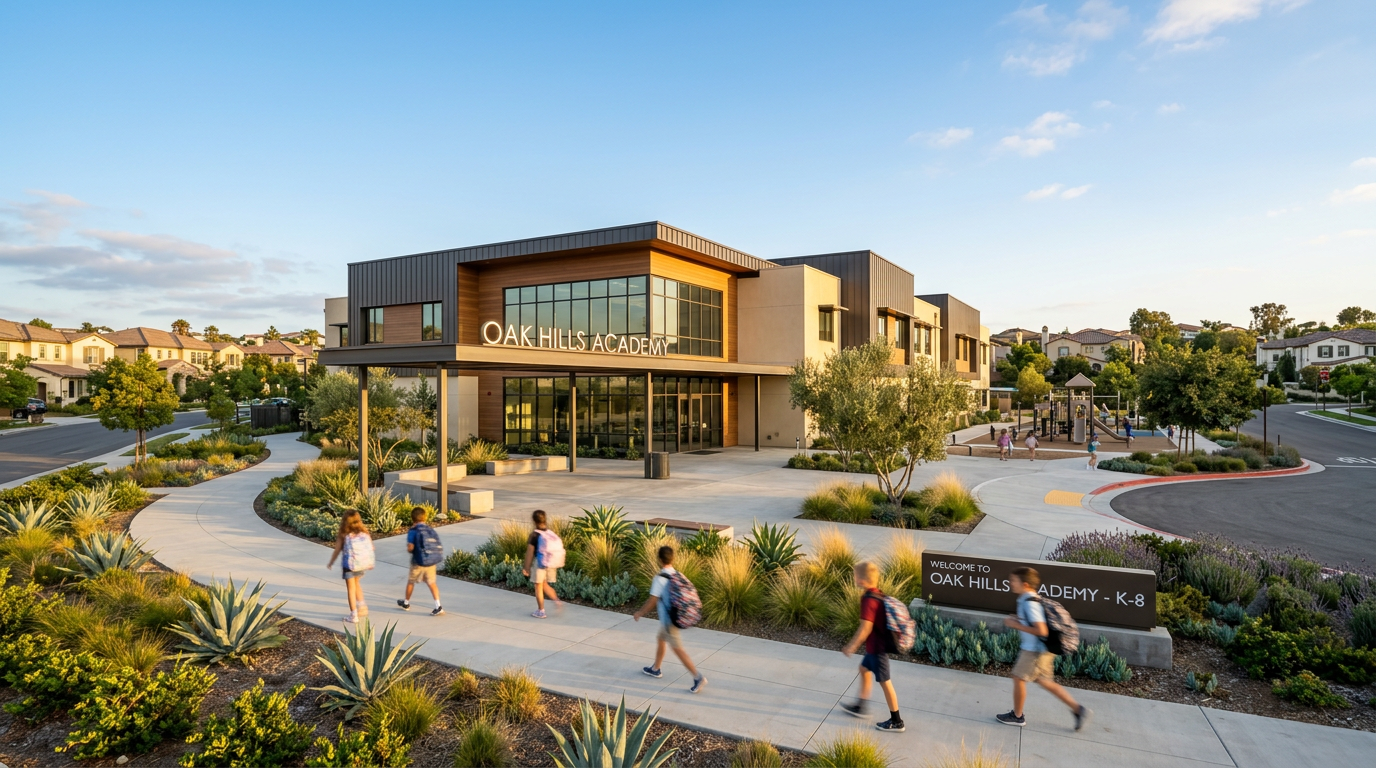
A major driver of real estate demand in the Great Park is the integration of Irvine Unified School District (IUSD) campuses directly into the neighborhoods. The master plan specifically rejected the traditional model of busing students to distant schools. Instead, K-8 schools were built as the literal centerpieces of the newer neighborhoods.
Beacon Park K-8, Cadence Park K-8, and Solis Park K-8 are woven into the residential streets, allowing children to walk or bike to school without crossing major arterial highways. These campuses feature modern architecture, advanced technology labs, and collaborative learning spaces that reflect the newest educational standards.
At the high school level, the area is served by Portola High School, located on Irvine Boulevard at the northern edge of the park. Opened in recent years, Portola High features a massive theater, an aquatics center, and a state-of-the-art stadium, rivaling many junior colleges in its facilities.
However, buyers must be acutely aware of one critical reality: enrollment capacity. The rapid pace of homebuilding has occasionally outpaced school capacity. IUSD utilizes enrollment projections and, in some cases, lotteries or overflow assignments when a neighborhood school reaches maximum capacity. A home's physical location next to a school does not guarantee immediate placement there. Buyers should always verify current attendance boundaries and capacity status directly with IUSD before removing contingencies on a purchase.
The Housing Landscape: Density, Design, and Price Bands
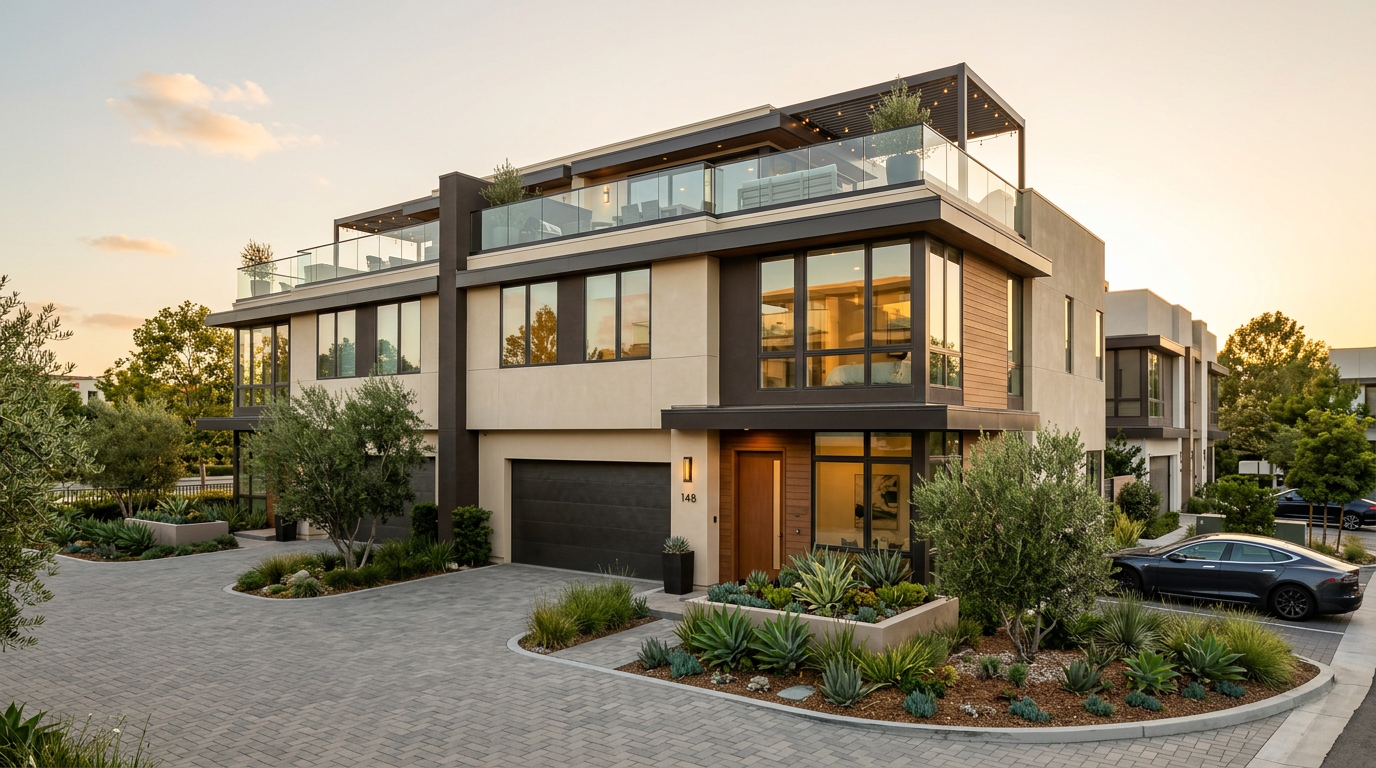
The architectural styling in the Great Park Neighborhoods is a sharp departure from the beige stucco and red-tile roofs that defined Irvine in the 1980s and 1990s. Here, you will find a mix of Mid-Century Modern, Art Deco, Farmhouse, and Contemporary styles.
The most important factor for buyers to understand is the density. Land values in Irvine are at a premium, and the Great Park was designed to maximize housing units.
Because yards are small, daily life heavily utilizes the community parks. It is common to see residents congregating at the neighborhood fire pits or clubhouses in the evenings, fostering a highly social, urban-suburban hybrid lifestyle.
- Attached Townhomes and Stacked Flats: These represent the entry-level price bands in the area. They often feature tandem garages, shared walls, and no private outdoor space beyond a balcony.
- Three-Story Detached Homes: A very common layout in the newer parks. These homes offer zero lot lines (very little space between houses), minimal or non-existent backyards, but often feature expansive rooftop decks for outdoor entertaining.
- Luxury Detached Homes: The highest price bands feature larger footprints, multi-generational suites (sometimes with separate entrances), and high-end builder upgrades, though lot sizes remain significantly smaller than older Irvine neighborhoods.
Traffic, Commutes, and Daily Logistics
Geographically, the Great Park is well-positioned for commuters. The 133 Toll Road runs directly along the eastern edge, providing rapid access to the 241 Toll Road (toward Riverside County or Yorba Linda) and the 73 Toll Road (toward Newport Beach and South County). The 5 Freeway is immediately accessible to the south.
For those utilizing public transit, the Irvine Station is located just outside the park's southern boundary, offering Metrolink and Amtrak Pacific Surfliner services—a major benefit for hybrid workers commuting into Los Angeles or San Diego.
However, local traffic requires patience. Irvine Boulevard, the main east-west artery bordering the northern neighborhoods, experiences heavy congestion during the morning school drop-off window (typically 7:30 AM to 8:15 AM). Additionally, because of the dense housing and high number of multi-generational households, street parking within the tracts can be extremely tight. Buyers should carefully evaluate the garage configuration (side-by-side vs. tandem) and the driveway length of any property they consider.
What Buyers Must Verify Before Offering
If you are preparing to purchase a home near the Great Park, your due diligence period must be thorough. Do not rely solely on builder marketing materials or neighborhood assumptions.
Living in the Great Park Neighborhoods offers a lifestyle unlike anything else in Orange County. It is vibrant, highly amenitized, and architecturally forward-thinking. By understanding the realities of the tax structure, the density, and the evolving nature of this massive landmark, you can make a confident, informed investment in Irvine's future.
For personalized guidance on navigating the Great Park real estate market, assessing Mello-Roos impacts, or comparing Irvine's various villages, contact Paul Phan at The Maison by Phan Group. Call (714) 717-8088 or email paul@maisonbyphan.com to schedule a consultation.
- Verify School Capacity: Use the IUSD school locator tool, but follow up with a phone call to the district. Ask specifically if the neighborhood school currently has a waitlist or overflow policy for your child's grade level.
- Analyze the Tax Bill: Request a copy of the seller's most recent property tax bill. Identify the exact Mello-Roos line items and ask your agent to verify when those specific bonds are scheduled to mature (though many run for 30 to 40 years from the date of construction).
- Check Parking Rules: Review the HOA CC&Rs regarding parking. Many tracts strictly prohibit parking in driveways if they overhang the sidewalk, and street parking may require permits or be highly restricted.
- Understand Future Zoning: The Great Park is still being built. Look at the City of Irvine's master plan for the parcels adjacent to your prospective home. A quiet dirt lot today could be zoned for a busy retail center, a parking structure, or an amphitheater tomorrow.
Disclosure
Market information is provided for general education and reflects conditions at the time of writing. It is not legal, tax, or investment advice.
Frequently Asked
Are schools in the Great Park neighborhoods guaranteed for residents?
No. While schools like Beacon Park K-8 and Solis Park K-8 are built into the neighborhoods, rapid growth means some campuses reach capacity. IUSD may utilize lotteries or overflow assignments to nearby schools, so buyers must verify current status with the district.
What is Mello-Roos, and how much does it cost in the Great Park?
Mello-Roos is a special tax assessment used to fund the community's infrastructure, schools, and parks. In the Great Park, it can push the effective property tax rate to between 1.3% and 1.8% of the home's value, adding hundreds or thousands to the annual tax bill.
Do homes in the Great Park have large backyards?
Generally, no. The master plan favors high density and shared community spaces. Most homes feature zero lot lines, small patios, or rooftop decks, relying on the extensive network of neighborhood parks and pools for outdoor recreation.
How does traffic in the Great Park compare to older Irvine neighborhoods?
Because the Great Park is a regional destination with a massive sports complex and water park, weekend traffic can be heavy during tournaments. Additionally, morning commutes on Irvine Boulevard are highly congested due to the concentration of schools.
Talk it through
Have a question about your own situation?
Paul Phan represents buyers and sellers across Orange County — in English and Vietnamese.
(714) 717-8088Continue reading
Market
Buying Historic Santa Ana: Downtown Homes & School Choice
Downtown Santa Ana offers some of Orange County's most stunning historic architecture paired with a unique, choice-based educational landscape. Discover how to navigate neighborhood boundaries, charter school proximity, and historic homeownership.
Market
Downtown Huntington Beach & Pier: Coastal Real Estate Guide
Living near the Huntington Beach Pier offers unparalleled access to surf culture and coastal amenities, but it comes with unique real estate realities. Discover what buyers need to know about the Downtown grid, parking, and narrow-lot architecture.
Market
Homes Around Mile Square Park: Fountain Valley Neighborhoods
Mile Square Regional Park is the 607-acre crown jewel of Fountain Valley, offering residents an unparalleled outdoor lifestyle right in their backyards. For homebuyers, navigating the neighborhoods that border this massive green space requires understanding hyper-local traffic patterns, school boundaries, and architectural nuances.
